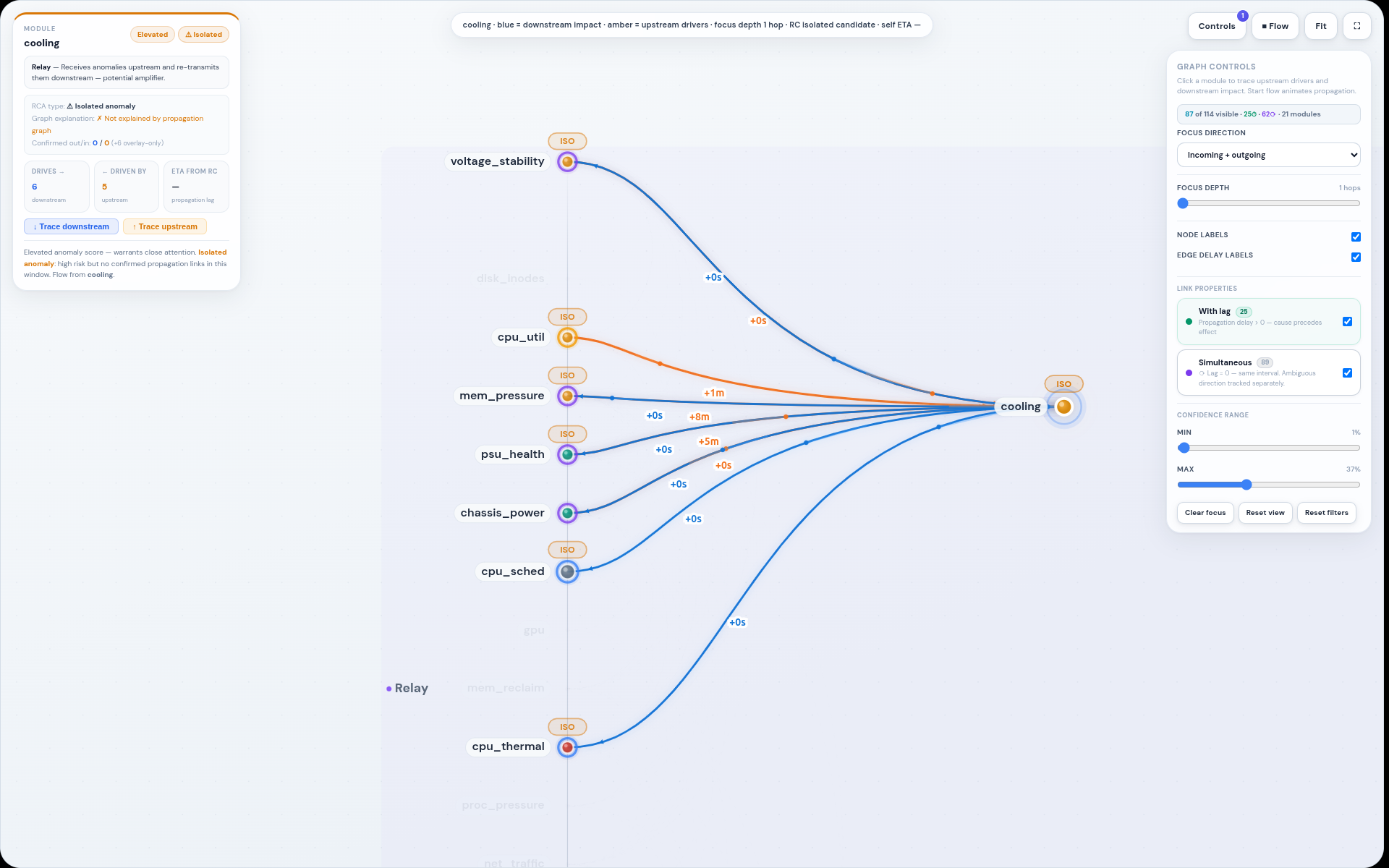
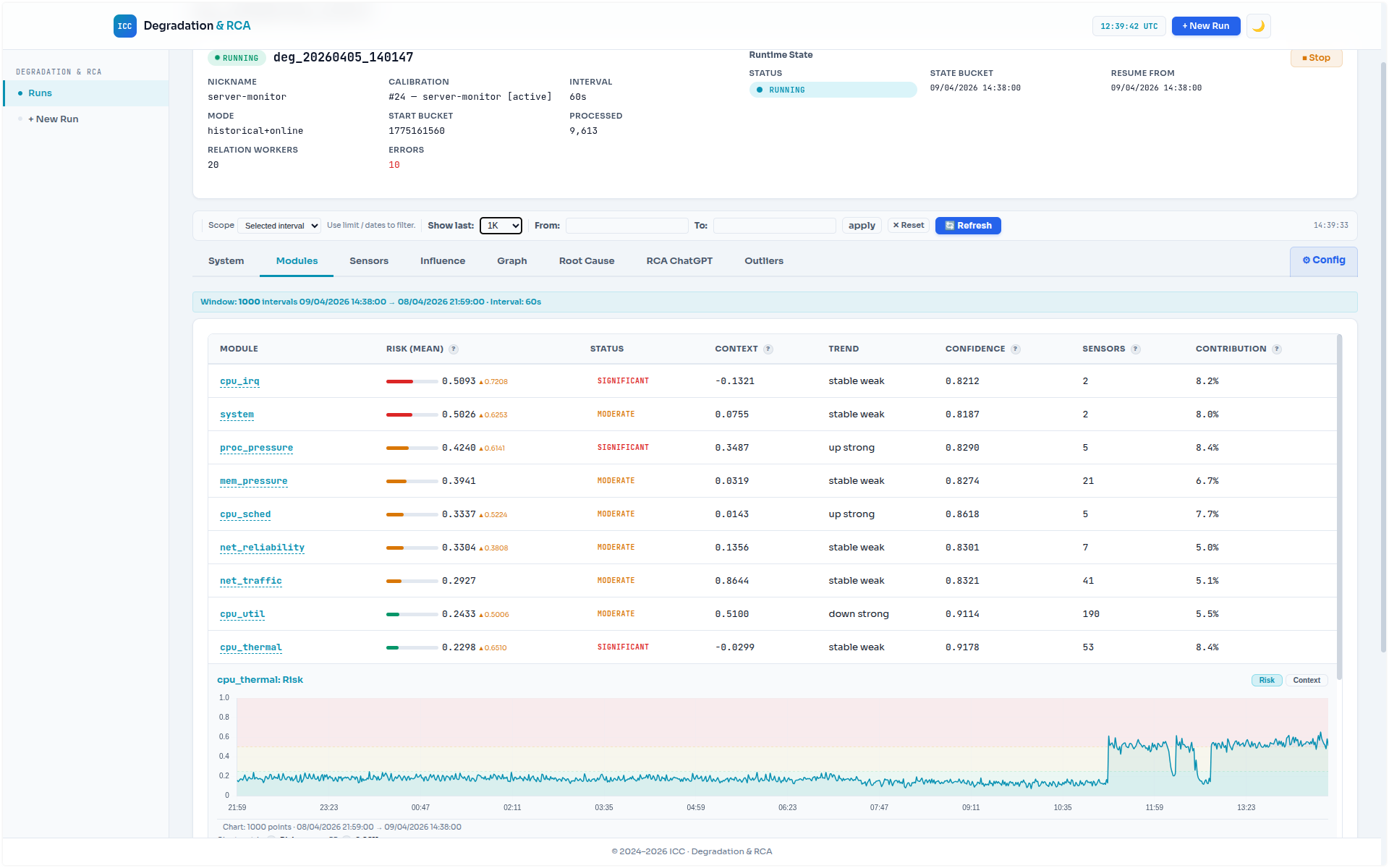
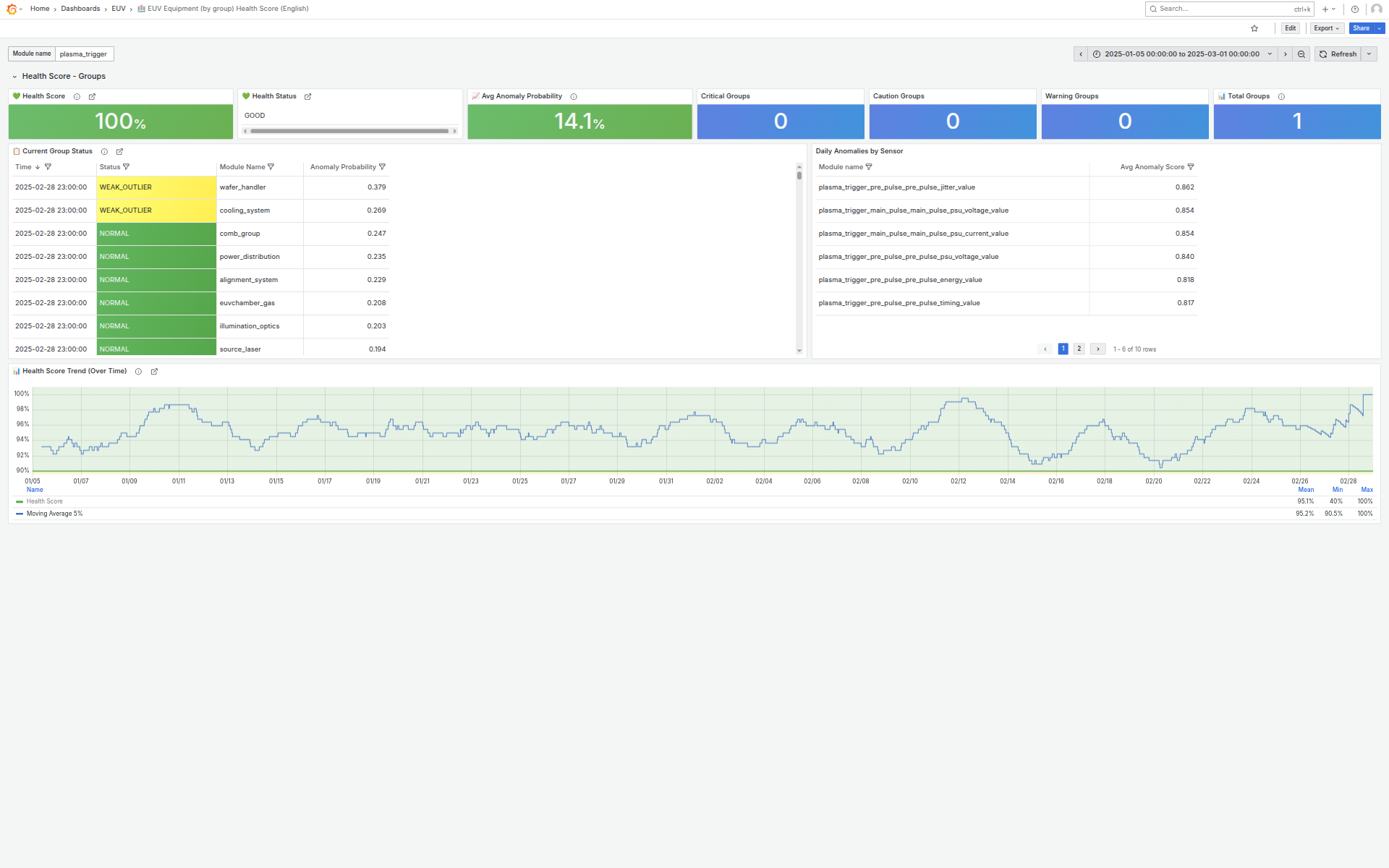
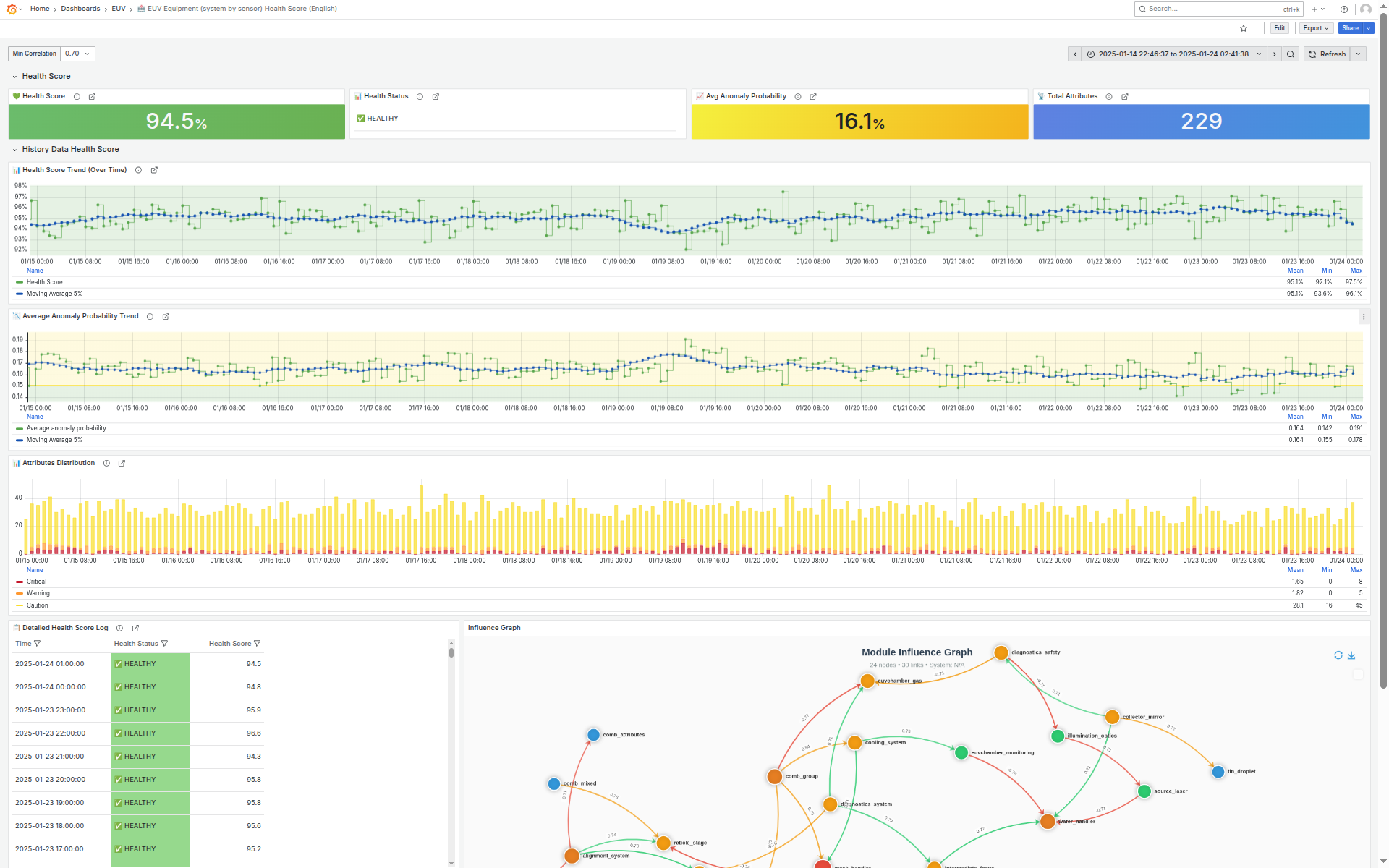
Core mechanisms implemented (early-stage)

Industrial Cognitive Core

An early-stage, supervised reasoning layer for telemetry-driven triage and decision support. It operationalizes reasoning with state, memory, tools, verification and governance.

A cognitive layer on top of existing data platforms — not a generic chatbot, not a dashboard wrapper.

Most industrial issues are detectable — but not explainable fast enough.

Reduces incident triage time, improves consistency of conclusions and preserves expert reasoning as reusable context.

Foundation: ICC builds stable representations of machine state ("state fingerprints"). These fingerprints support evidence comparison, structured reporting and (optionally) LLM-assisted reasoning.
Autonomous agent workflows are layered on top gradually and only in supervised modes.

Reasoning Cycle (supervised)
👁

Observe

Telemetry snapshots & change detection

🔍

Interpret

State fingerprints & similarity evidence

🧠

Reason

Hypotheses & next-best checks

Act

Queries, checks, workflows (human-approved)

📈

Learn

Feedback, confidence, incident memory

Who ICC is For

🏭 Complex Systems

Teams dealing with dense telemetry and complex interactions beyond simple threshold alerting

⏱️ Slow Triage

Environments where incident triage is slow, inconsistent and dependent on a few experts

🔐 Traceability

Organizations that need evidence-based, auditable outputs and human control over actions

🎯

State Fingerprints

Compact state representations with human-readable structure plus a comparable vector embedding.

🔗

Model-Agnostic

LLM is optional and replaceable.
ICC provides state + evidence + tool grounding for consistent reasoning.

🛡️

Human-in-the-Loop

Permissions, evaluation gates and supervised tool use.
No operational actions without approval.

✓ We Are

  • A reasoning layer for telemetry triage
  • Evidence + state representation engine
  • Supervised workflows with traceability
  • Designed to complement existing data platforms

✗ We Are Not

  • A generic chatbot or thin LLM wrapper
  • A monitoring/alerting product
  • A fully autonomous control system
  • Black-box automation without evidence

⚙️ Under the Hood

ICC is built around state fingerprints and an evolving world-state representation. Agent capabilities are developed incrementally on top of this foundation.

Cognitive Core in Action

Example of First End-to-End Reasoning Result: From User Query to Answer

What the ICC Is

A cognitive layer that transforms high-volume industrial telemetry into compact state representations and evidence packs, enabling traceable decision support.

The Industrial Cognitive Core

ICC operationalizes reasoning by providing state, history and tool-grounded evidence.

It normalizes noisy telemetry, extracts structure and produces stable state fingerprints that can be compared over time. This makes explanations more consistent and supports repeatable triage workflows.

An LLM (if used) acts as a replaceable reasoning component. ICC provides the surrounding system needed for grounded outputs: memory, verification, permissions and audit.

What ICC is NOT

Generic chatbot or thin prompt wrapper
Monitoring / alerting platform replacement
Autonomous control system
🎯

Perception & State Estimation

Telemetry → stable fingerprints (interpretable + vector) and compact evidence packs for downstream reasoning

🧠

Reasoning & Decision Support (early-stage)

Structured hypotheses and next-best checks, grounded in evidence; reasoning depth expands step-by-step

🔧

Tool Use & Verification

SQL / APIs / workflows executed in supervised modes; conclusions grounded in tool outputs, not text-only

💾

Memory (prototype)

Incident traces and similarity retrieval to support "have we seen this before?" workflows

🛡️

Governance & Safety

Human-in-the-loop controls, scoped permissions, evaluation gates and audit logs

🔗 Why State Matters for Reasoning

LLMs do not observe machines directly.
ICC provides structured state, history and evidence to make reasoning more grounded, comparable and auditable.

System Architecture (illustrative)

This diagram is a high-level view intended for communication. Implementation details evolve and are not disclosed here.

ICC System Architecture Diagram showing data flow from telemetry to reasoning

State Fingerprints

Compact and structured representations of equipment state derived from heterogeneous telemetry. Examples below are illustrative and do not represent a public data schema or fixed implementation.

Interpretable Structure Semantic

Human-readable summaries that capture system condition and context, designed for engineers and for grounded reasoning workflows.

Aggregated indicators and behavioral summaries
Context and data-quality signals
Relational context between parameters (where applicable)
Incident-style evidence packaging
State Snapshot:
- summary: [...]
- indicators: [...]
- context: [...]
- evidence: [...]

Comparable Representation Mathematical

A compact numerical form that enables comparison of system states across time and operating conditions.

Supports comparison of system behavior over time
Enables retrieval of related historical states
Designed to be robust to noise and scale differences
Foundation for state tracking and forecasting experiments
[ abstract numerical representation ]
Specific encoding methods and comparison techniques are implementation-dependent and not part of the public interface.

Evidence & Similarity Reasoning

ICC compares fingerprints to surface drift, regime shifts and "closest known incidents". Similarity metrics (such as cosine similarity) are used as part of an evidence workflow—not as a standalone claim of correctness.

📊
Evidence packaging
🔗
Similarity retrieval
📈
Drift / change detection

Operational Reasoning Loop

A continuous loop that mirrors how expert engineers reason: evidence → hypotheses → checks → review.

1

Observe

Ingest telemetry snapshots from heterogeneous sources. Detect changes and candidate anomalies.

2

Interpret

Produce state fingerprints and evidence packs. Surface similar historical states and context.

3

Reason

Generate hypotheses and recommended next checks. Reasoning depth expands incrementally.

4

Act

Execute approved checks via tools (SQL/APIs/workflows). Log actions and results for auditability.

5

Learn

Capture outcomes and feedback as incident traces to improve future triage and consistency.

LLM (if used) is a replaceable reasoning engine.
ICC is the system that makes reasoning grounded, verifiable and safe.

⚠️ Actions are limited to supervised checks; no operational control is executed without explicit approval.

🔒 Data Handling (deployment-dependent)

ICC can be deployed to operate on derived state representations instead of raw telemetry streams, depending on customer constraints. This may reduce exposure of sensitive operational details, but it is not a substitute for enterprise security controls.

Deployment options: on-prem / customer-managed cloud. Data scope and access controls remain customer-defined.

Capability Status

The core representation + evidence workflow is implemented. Agent layer development is on pause — 2026 is focused on making the Core Layer pilot-ready with maximum simplicity.

Implemented (current prototype)

Core Layer
State fingerprints (interpretable + vector)
Similarity retrieval & change detection
Structured explanations & reporting output
Tool execution for checks (traceable)
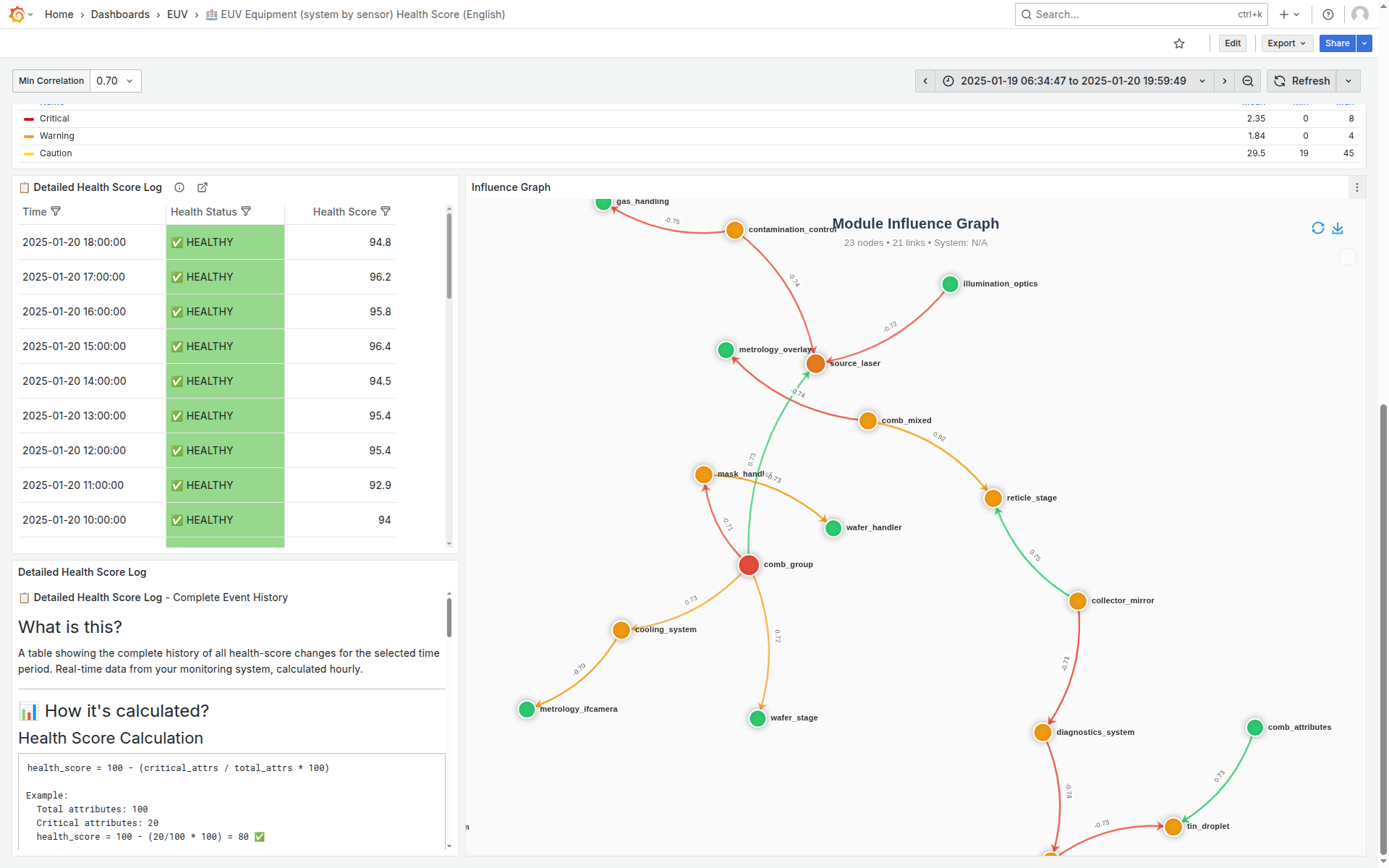
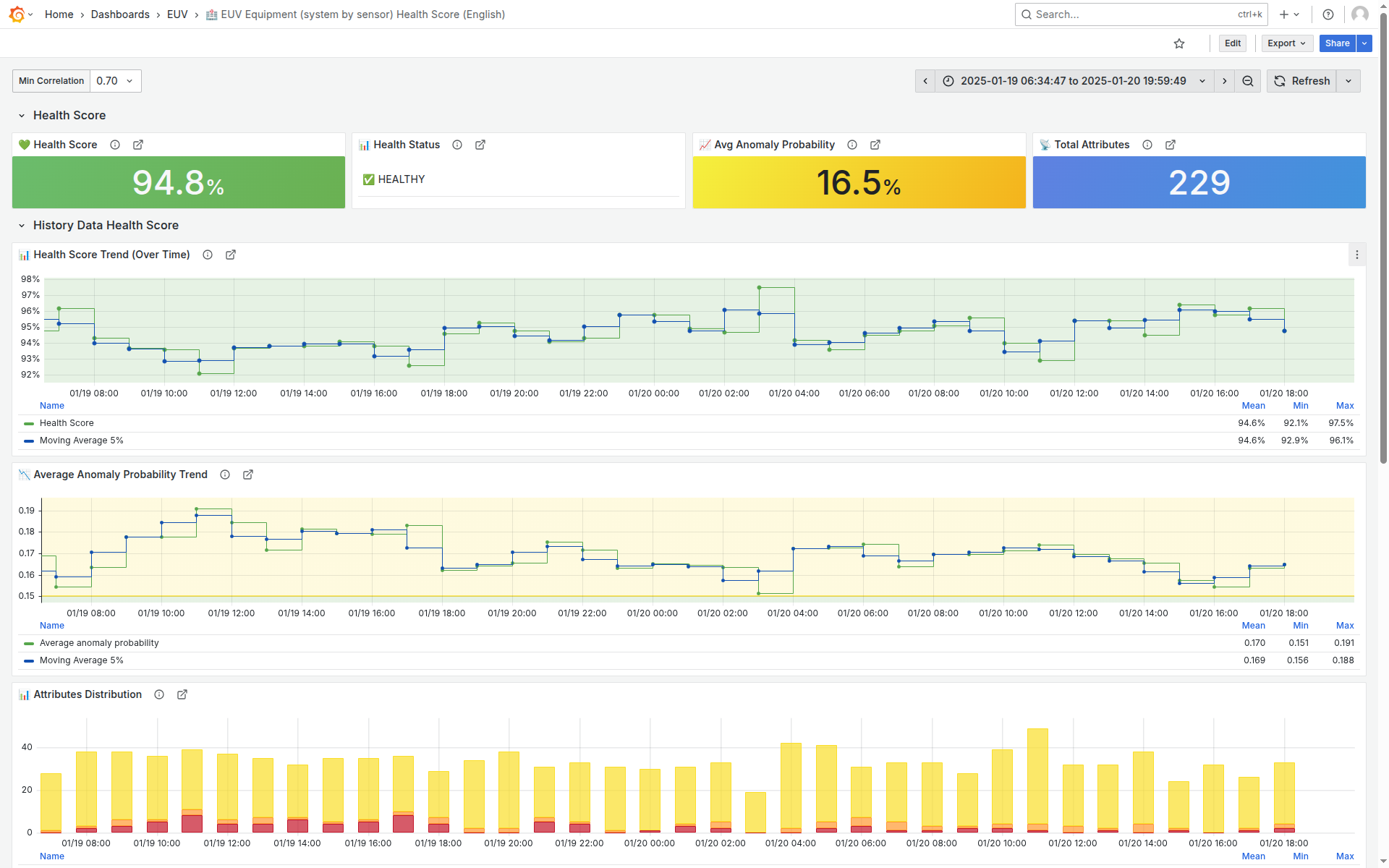
Grafana-based visualization layer

On Pause

Agent Layer
Multi-step reasoning workflows (expanding)
World-state tracking & forecasting mechanisms
Confidence signals & calibration
Governance gates & evaluation protocols
Memory hardening (incident traces, retrieval)
🎯

2026 Focus

Core Layer → Pilot-Ready
Streamline Core Layer into a minimal, ready-to-deploy package
Simplify installation and configuration for fast pilot onboarding
Harden reliability and reproducibility of core workflows
Deliver pilot-ready software that works out of the box
Reduce operator effort: maximum simplicity, minimum setup

What Success Looks Like

Measured relative to baseline triage and engineering review.

Faster Triage

Time-to-scope reduction

🎯

Narrower Scope

Cleaner incident boundaries

📋

Consistent Output

Repeatable explanations

💾

Reusable Knowledge

Searchable incident traces

How the system matures

ICC is developed via incremental, supervised workflows: define a bounded scope, replay historical incidents, collect engineer feedback and harden reliability. In 2026, the priority is making the Core Layer pilot-ready — a clean, minimal package that works out of the box with minimum setup. Agent Layer development resumes once the Core Layer is validated and stable.

Use Cases

Demonstrations of applicability across domains with dense telemetry and expensive expert triage.

These are applicability demonstrations — simulated environments used to exercise ICC's core workflow. They are not presented as production deployments.

Domains are chosen for shared structure: dense telemetry, complex interactions and high cost of expert time.

🚁
▶ Video
Simulated Data

Drone Telemetry

Telemetry triage for complex behavior: anomaly surfacing, state comparisons and explanation output.

🌪️
▶ Video
Simulated Data

Wind Turbines

Fleet-style monitoring scenario: drift, similarity retrieval and incident-style summaries.

🌊
▶ Video
Simulated Data

Submarine Cables

Segment-level telemetry scenario: state fingerprints, similarity evidence, structured explanation.

US Stock Market Analysis — ICC Backtest
Real Market Data

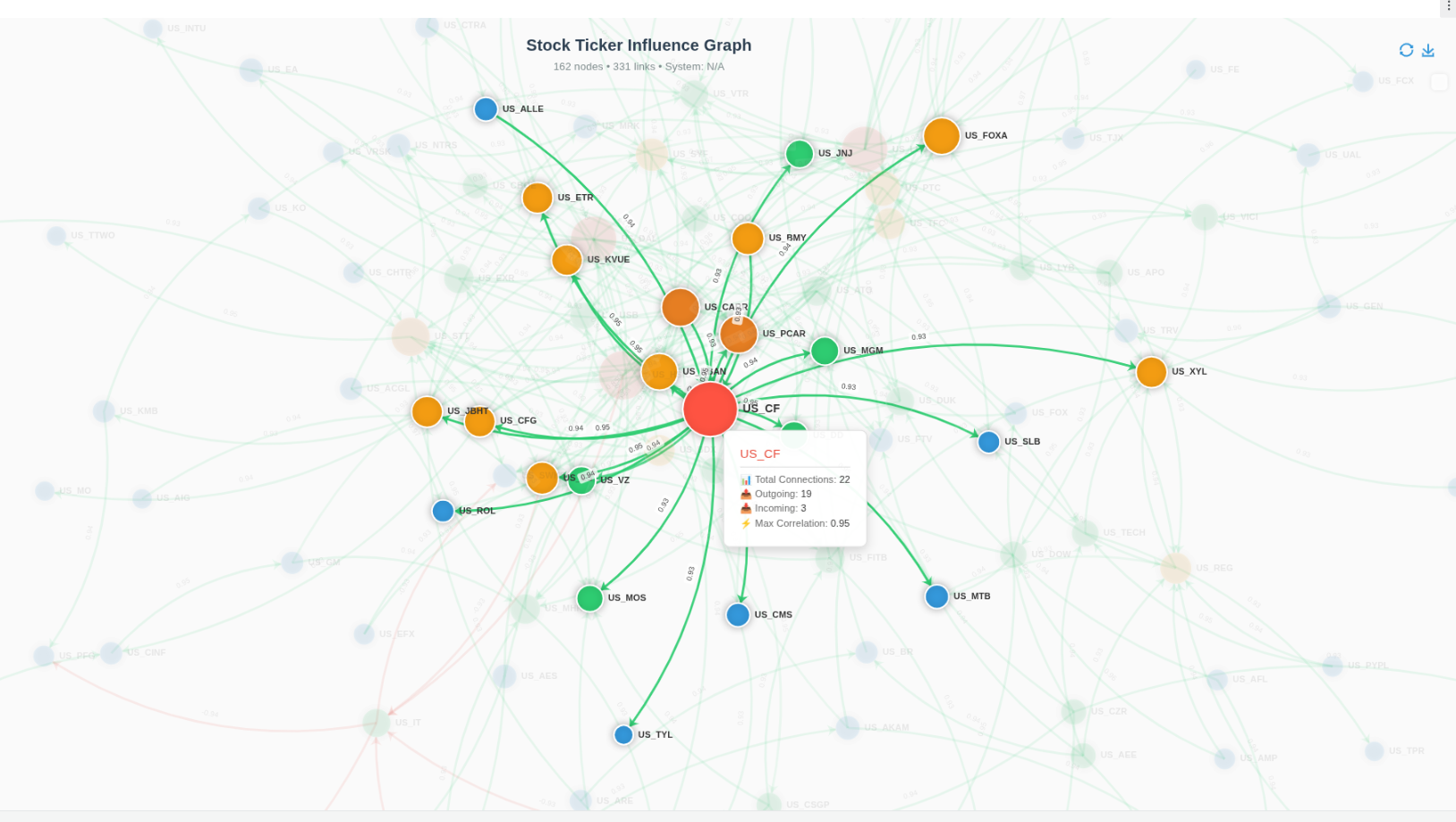
US Stock Market — Backtest with ICC

ICC decision engine loaded with US Top 500 market data. Multi-scenario backtest orchestrator with adaptive risk control, position management, trailing stops, and structured performance reporting.

📄 Download Backtest Report (PDF) →
Simulated Data

EUV Machine Telemetry

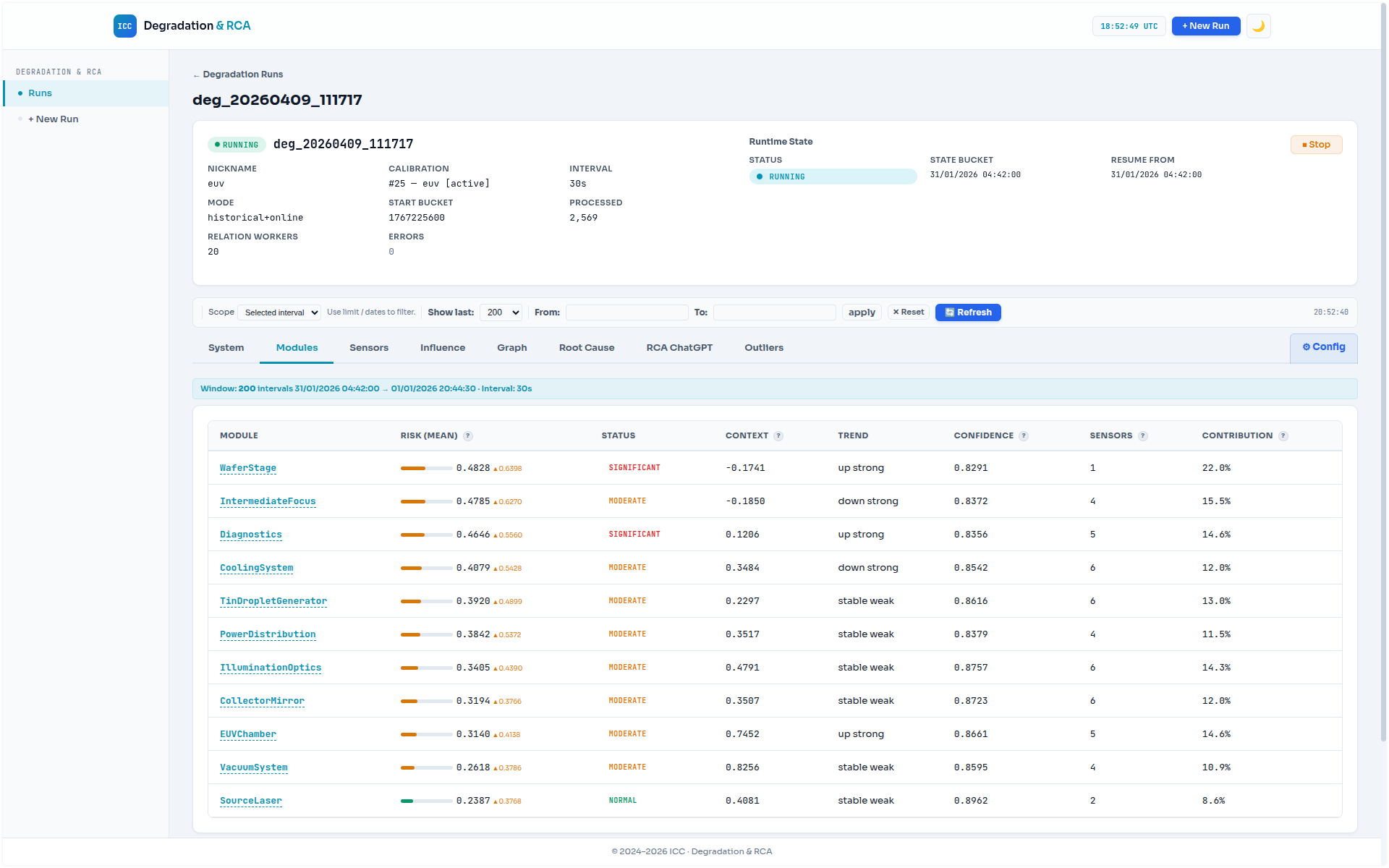
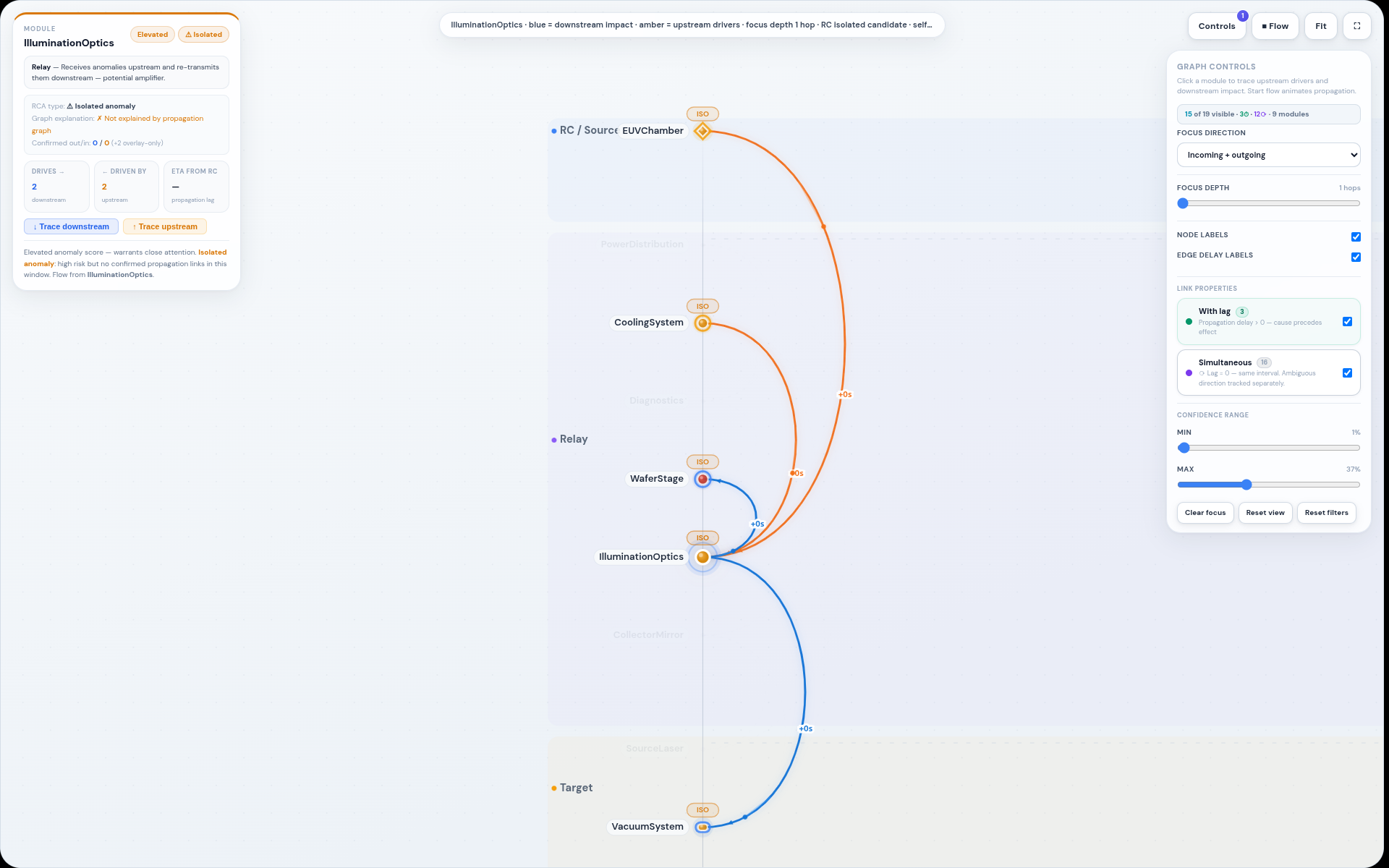
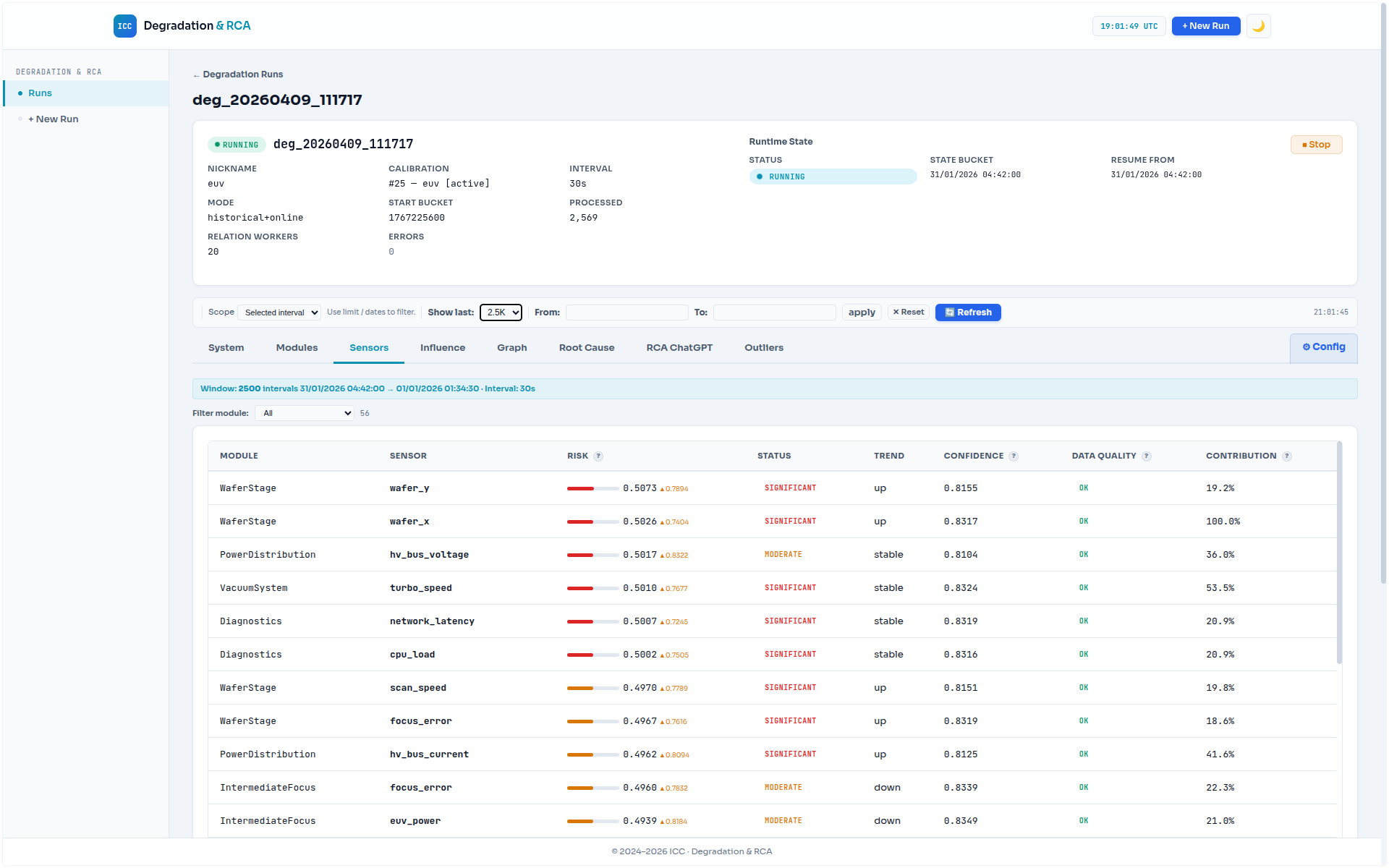
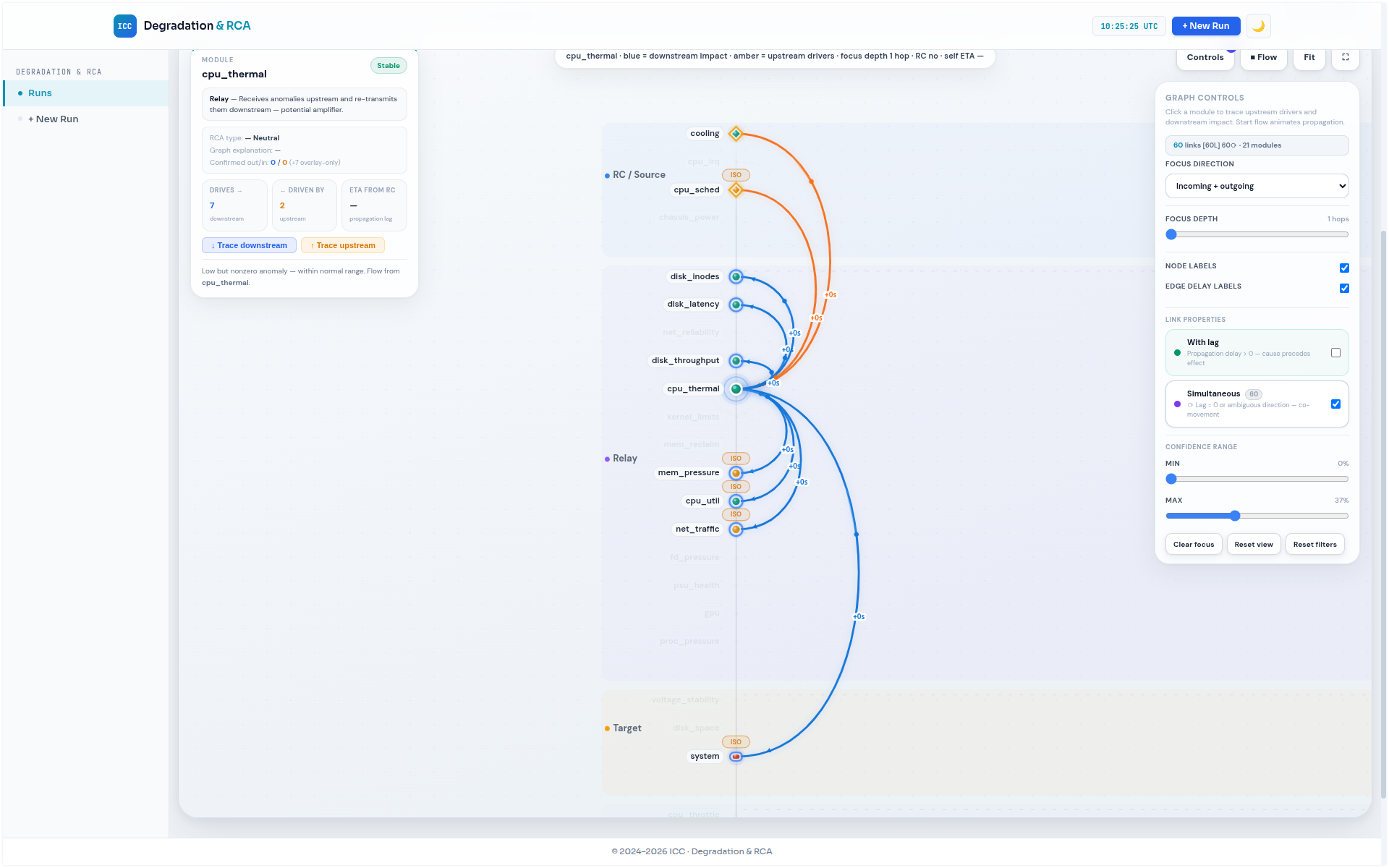
Exploratory applicability study using EUV-machine–inspired telemetry. Public demo uses simulated data..

Discuss applicability →

Use cases illustrate applicability of the core workflow, not production validation.

Applicable Scenarios

• Incident triage in complex equipment
• Root-cause narrowing
• Change impact analysis
• "Have we seen this before?" similarity evidence
• Structured anomaly explanations
• Financial market analysis & backtest orchestration

About ICC

Building industrial reasoning capabilities step-by-step, grounded in practical operational constraints.

We’re building AI that helps engineers reliably understand, explain, and operate industrial systems.
Grounded in telemetry evidence, clear reasoning, and verifiable checks — transparent, inspectable, and safe by design.
— Industrial Cognitive Core Vision

🚀 Why Now

Recent advances in LLMs make practical industrial reasoning systems possible — not because LLMs replace system logic, but because they can be used as a reasoning component within a larger cognitive engine. Two years ago, this architecture would have been difficult to make reliable. Today, it is.

🎯 What Makes ICC Different

ICC is not a proxy or wrapper around an LLM, but a standalone cognitive engine with its own world model, state tracking and decision logic. Outputs are structured and traceable, designed for human oversight. The product complements existing data platforms rather than replacing them.

Developed by an engineer with experience in industrial telemetry, anomaly analysis and cognitive system design.
Based in Eindhoven, Netherlands.

Conceptual Interaction Examples Future Interaction

These are illustrative examples of how interaction may look as the product evolves. They show the expected shape of answers (evidence + checks + bounded conclusions) — not a live chat and not current functionality.

Transcript 1: Morning shift check
Illustrative
Is Line A ready for production? Any issues overnight?
👤
🧠
Status (bounded) Line A looks stable for start-up. No critical alarms in the last window.
  • Most signals are within expected operating band
  • No evidence of escalating drift in the last hours
  • Data quality: sufficient for a confident "go"
Anything I should watch in the first hour?
👤
🧪
First-hour checks I'd watch for early deviation in: temperature stability, vibration trend and hydraulic response time. If any of those drift consistently, I'll propose the next-best verification check.
Transcript 2: Pump degradation investigation
Illustrative
Production is slower. Operators suspect hydraulics. What's going on with Pump 2B?
👤
🧠
Evidence summary Pump 2B shows a degradation-like pattern compared to its recent baseline.
  • Flow trending down while effort/heat indicators trend up
  • Noise/vibration indicators elevated vs. prior "known-good" period
  • Impact: consistent with efficiency loss (not yet a confirmed failure)
What's the safest next step — keep running or stop?
👤
🛡️
Recommendation (supervised) If you can reduce load briefly, do it — then run a verification check:
  • Compare against the closest "healthy" state fingerprint
  • Confirm whether the trend persists under reduced load
  • If indicators continue worsening, escalate to maintenance / controlled stop

Explore Collaboration

If you manage complex systems with dense telemetry and recurring triage load, we can discuss applicability and evaluation approach.

Contact Us →